
High-Quality
Link Building Services
for SEO and AI Visibility
A business without strong digital visibility is like a store hidden down a side street: the offer may be excellent, but the right people never find it. A polished website and strong content still need discoverability, relevance, and a High-Quality Link Building Services. Google says that the same SEO best practices still apply in its AI search experiences, and its documentation also states that links help its systems find pages and understand relevance.
That is why modern link building still matters. Not because search works on a single “authority score,” but because search and AI systems need evidence that your pages are connected, referenced, and useful in context. Google’s ranking systems use many signals at the page level, while AI features can surface supporting links from a wider and more diverse set of pages than a classic web result.
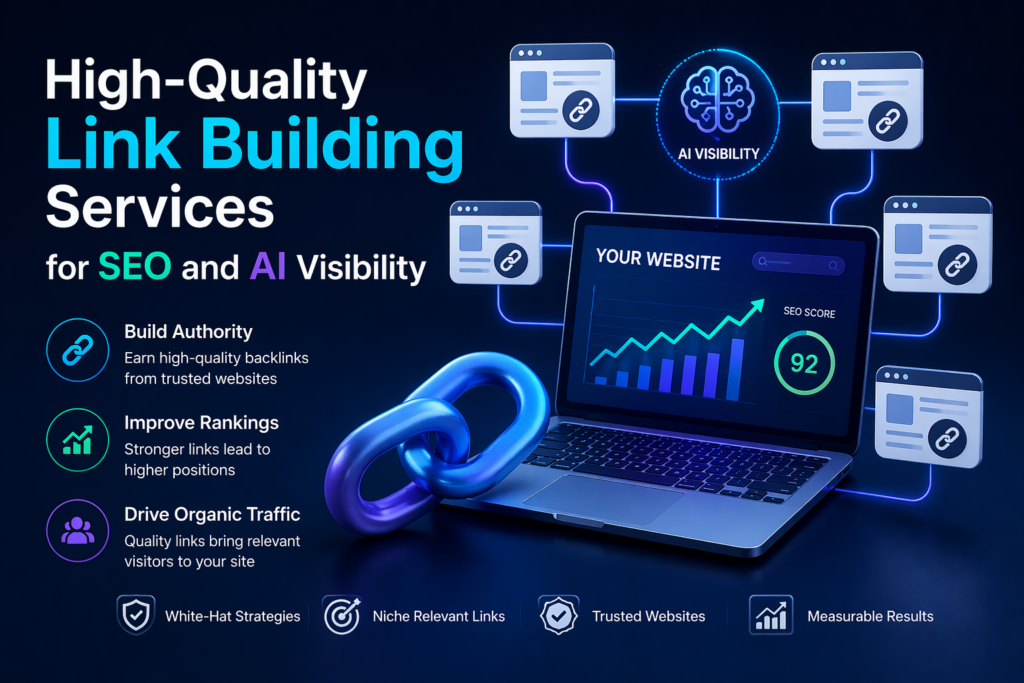
Why link building still matters
Links still play two practical roles in search: they help Google discover pages to crawl, and they help Google understand what linked pages are about. That is why crawlable HTML links, relevant context, and descriptive anchor text matter more than vague “click here” links or decorative navigation. Google also recommends that every important page on your site should be linked from at least one other page on your own site.
When relevant websites mention and link to your business, you gain more than a possible ranking benefit. You create clearer topic associations around your brand, additional paths through which prospects can reach you, and stronger context around the pages you most want to rank. Google’s own guidance notes that external links can help establish trustworthiness when they are used to cite sources or add useful context for readers.
In other words, link building is not a side tactic. It is part of how strong pages become easier to discover, easier to interpret, and easier to trust across both traditional search and AI-assisted search experiences.
What modern link building looks like
Modern link building is not automated link blasts, excessive reciprocal exchanges, or paid links designed to pass ranking credit. Google’s spam policies classify buying or selling links for ranking purposes, excessive link exchanges, advertorials with optimized anchors, and automated link creation as link spam. Google has also said its SpamBrain systems can detect and neutralize unnatural links, meaning manipulative campaigns may simply lose value rather than create lasting gains.
A stronger approach to High-Quality Link Building Services is editorial, relevant, and audience-aware.
It focuses on placements people would actually read, pages that make topical sense, and anchor text that is descriptive, concise, and natural in context. Google’s documentation explicitly recommends descriptive anchor text and warns against forcing excessive keywords into anchors.
It also means treating paid visibility and editorial visibility differently. If a link is an advertisement or paid placement, Google recommends qualifying it with rel=”sponsored” and accepts nofollow as an alternative. That matters because a professional service should build brand reach and referral value without crossing into tactics that violate search policy.
How our service builds authority the right way
At SEOxRANK, we approach link building as a strategy, not a volume game. We start with the pages that matter most to your business: core service pages, high-intent landing pages, and the support content that helps those pages compete. Then we map which topics, mentions, and content gaps surround those pages so outreach is driven by relevance instead of vanity metrics. That aligns with Google’s page-level approach to ranking and its emphasis on contextual internal linking.
From there, we build assets worth citing. That can include service explainers, comparison pages, expert commentary, original statistics roundups, resource pages, or thought-leadership content that publishers and niche sites can actually reference. Google’s people-first content guidance emphasizes original information, substantial coverage, and content that leaves the reader feeling they learned enough to achieve their goal. A GEO research paper similarly found that citations, quotations, and statistics improved source visibility in generative-engine responses.
We also treat internal linking as part of authority building, not as an afterthought. Google recommends that every important page be linked from at least one other page on your site, with concise and descriptive anchors. That means a strong service page should not stand alone; it should sit inside a well-connected content system that helps both users and crawlers understand where it fits.
Why this matters for AI search visibility
For AI Overviews and AI Mode, Google explicitly says there are no extra technical requirements, no special schema, and no need for AI-specific text files or markup. What still matters is the same foundation that supports strong SEO generally: crawlability, internal links, page experience, important content in visible text, and structured data that matches the visible content on the page.
Outside Google’s own documentation, generative-search research points in a similar direction. One GEO paper reported source-visibility gains of up to 40% in generative-engine responses and highlighted the value of citations, quotations, and statistics. A later AI-search study found that these systems lean heavily toward earned third-party media, differ by engine and language, and reward machine-scannable, well-justified content. Taken together, these sources support a clear inference: a modern link-building page should be evidence-led, clearly structured, and written in a way that is easy for AI systems to quote, summarize, and cite.
That is also consistent with Google’s people-first framework. Google asks whether content demonstrates first-hand expertise, has a clear purpose, and leaves the reader feeling satisfied rather than needing another search. For a commercial page like this one, that means explaining what link building is, what good practice looks like, what bad practice looks like, and how the service actually creates value.
Common questions about link building services
How long does link building take to make a difference? It is not usually immediate. Google states that meeting requirements and best practices does not guarantee crawling, indexing, or serving, and it notes that some changes can take days to weeks to be recrawled and reprocessed. High-Quality Link Building Services works best as a compounding strategy rather than an instant-result tactic.
Are all backlinks good backlinks? No. Google’s spam policies explicitly warn against manipulative link schemes, and its link spam systems are built to neutralize unnatural links. Relevance, editorial context, and compliance matter more than raw link volume.
Do paid placements have a place in a professional strategy? They can have branding, audience, and partnership value, but Google says that links which are advertisements or paid placements should be marked with rel=”sponsored” or, alternatively, nofollow. Paid links intended to manipulate rankings fall under link spam.
Can link building help AI search visibility too? Potentially yes, especially when it increases earned mentions from credible third-party sites and supports content that is easy to parse and cite. Google says AI search still relies on standard SEO foundations, while generative-search research indicates that earned media and explicit evidence can materially improve citation visibility.
Who this service is for
Professional link building is most useful for businesses that already have a real offer, solid pages, and a site worth promoting. It is especially valuable in competitive spaces where many businesses publish similar pages and need stronger signals of relevance and trust. Google’s own documentation makes clear that ranking uses many signals, not one; that is exactly why link building works best when it strengthens already-useful pages instead of trying to compensate for weak ones.
It is also a strong fit for brands that want more than a temporary ranking bump. The broader goal is to build trusted mentions, stronger discovery paths, and a site that is easier for both users and search systems to understand. In AI search environments that often favor earned third-party references, that broader reputation-building role becomes even more important.
If you want a cleaner, safer, and more evidence-based approach to authority building, SEOxRANK can build a custom link strategy around the pages that drive your revenue, the publications that matter in your market, and the content formats that are most likely to earn real citations. The goal is not “more links at any cost.” The goal is better visibility, stronger trust, and a durable competitive advantage.